In the last years, there has been a growing importance of cycling in the political arena. Pushed by the agenda for sustainable mobility and healthier behaviours, cycling has slowly but steadily become a priority. At the same time, research on cycling has also increased significantly, building know-how on bringing about modal shift. Research has so far focuses on ‘champion cities’ (holding cycling modal shares above 20%) and as such on most successful examples. On the opposite scale, ‘starter cities’ seem to be in a particularly disadvantaged situation, having no cycling tradition nor technical know-how, with little research specifically focused on the problems and solutions for these cities. This project seeks to contribute to bridge this gap. Within this context, project “BooST – Boosting Starter Cycling Cities” focuses on starter cities and aims to provide specific technical know-how to allow them to reach the next level of bicycle use.
With this in mind, the project developed a Starter City Roadmap providing a toolkit, which includes the assessment framework of the Gross Potential for Cycling (GPC), the assessment framework of the Economic Value for Cycling (EVC), and the framework of the Cycling Measures Selector (CMS) best suited for starter cities.
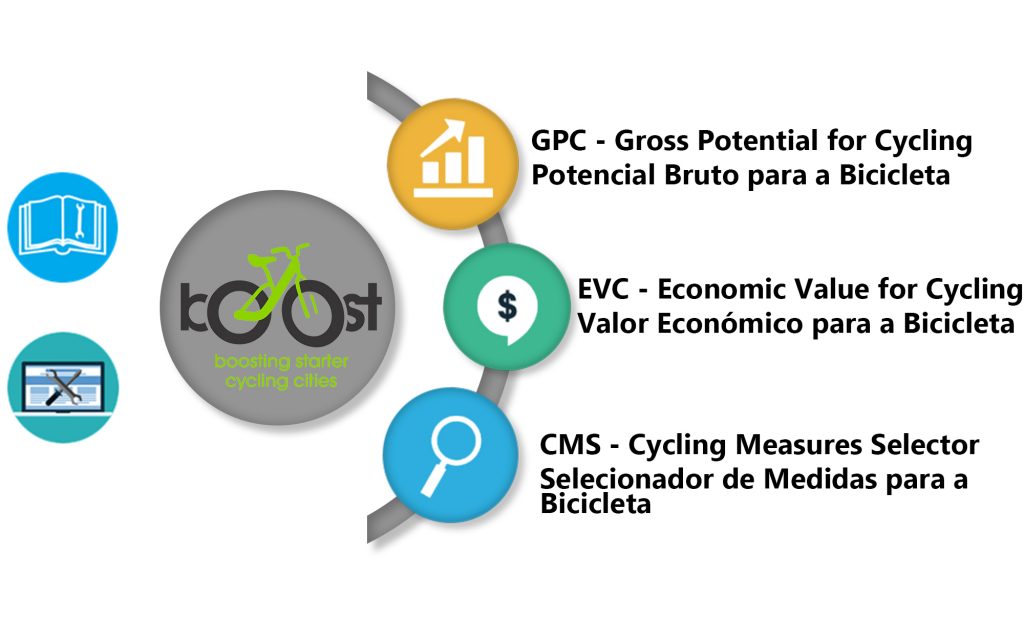
The Starter City Roadmap and its toolkit will be made available in the form of a manual and of an interactive website and through several local workshops involving local authorities and other stakeholders. Together with a ranking of national starter cities (regarding their gross potential) the project will empower local policy with technical know-how and arguments against the general skeptical attitudes towards cycling.
The project brings together several experts and builds on prior research on Mobility Management at the Research Centre for Territory, Transports and Environment (CITTA), the promotion of cycling at University of Aveiro(UA), with several ongoing projects and research activities in the field, and the broad expertise of the European Cyclists’ Federation (ECF).
Research Team

Cecília Silva

José Carlos Mota

Frederico Moura e Sá

Isabel Cunha

João Pedro Ferreira

Catarina Isidoro

Joana Marques

Catarina Cadima

João Teixeira

Luiza Bandeira

Tamara Bicalho

Ana Mélice Dias

Miguel Lopes
Institutions
Porto University – Engeneering Faculty (FEUP) & Aveiro University (UA)


Investigation Centre for Territory, Transports and Environment (CITTA) & Investigation Unit for Governance, Competitiveness and Public Policies (GOVCOOP)


Partners


Support


Cities
| Amadora | Lisbon | Odivelas | Trofa |
| Beja | Loures | Oeiras | Valongo |
| Chamusca | Machico | Portimão | Vila Nova de Gaia |
| Condeixa-a-Nova | Maia | Porto | |
| Fundão | Marco de Canavenses | Santa Maria da Feira | |
| Gondomar | Matosinhos | Tavira |
Financing
This project (ref. POCI-01-0145-FEDER-031479) is funded by the European Fund for Regional Development (FEDER), through COMPETE2020 – Operational Program Operational Competitiveness and Internationalization (POCI) and by national funds (PIDDAC) through FCT/MCTES.
